
Quick Answer: An airline interview is a multi-stage assessment — typically a psychometric test, a technical interview, a competency-based interview, and sometimes a simulator check. Each stage tests something different. This guide covers what to prepare, in what order, over a realistic timeline — with the specific focus on EASA-trained pilots applying to European carriers.
Table of Contents
- What an Airline Assessment Actually Looks Like
- Stage 1: The Application and CV
- Stage 2: Psychometric and Aptitude Tests
- Stage 3: The Technical Interview
- Stage 4: The Competency-Based Interview (CBI)
- Stage 5: The Simulator Check
- The 4-Week Preparation Plan
- The Day Before and Day Of
- Key Takeaways
- FAQ
- Conclusion
What an Airline Assessment Actually Looks Like
Most pilots applying for their first airline job have no clear picture of what the full assessment process involves — and that uncertainty is one of the main reasons preparation suffers.
A European airline selection process typically consists of the following stages, though not every airline uses all of them:
- Online application and CV screening — automated and human filter to check minimum requirements
- Psychometric and aptitude tests — cognitive ability, multi-tasking, spatial reasoning, personality
- Technical interview — ATPL theoretical knowledge, operational judgement
- Competency-based interview (CBI) — behavioural evidence of core pilot competencies
- Simulator check — basic handling, instrument flying, non-normal procedures, CRM
- Medical and background verification — Class 1 medical confirmation, employment history
Low-cost carriers often compress the process — a single assessment day covering technical, CBI, and sim in one session. Full-service carriers typically run staged eliminations with weeks between rounds.
One thing is consistent across all carriers: every stage is eliminatory. Failing the psychometric test means you never reach the technical interview, regardless of how strong your theory knowledge is. This matters enormously for how you allocate your preparation time.
Stage 1: The Application and CV
Before you can be interviewed, you need to be invited. The application stage is where many candidates quietly eliminate themselves without realising it.
The CV
Airline CVs follow a specific format that is different from any other industry. One page, always. Reverse chronological order. Licences and ratings at the top, flight experience clearly quantified (total hours, PIC hours, multi-engine, instrument, turbine if applicable), followed by employment history and education.
The most common mistakes: too long, too much text, missing licence details, or formatted in a way that makes it hard for a recruiter to find the numbers they are scanning for. Your CV is not a document people read — it is a document people scan in 15 seconds.
Research the airline before you apply
You will be asked — at some point in the process — why you want to work for this specific carrier. 'Because you're hiring' is not an answer. Know the fleet, the network, the recent news, the company values, and the culture. Know what base you're applying to and what the typical progression looks like.
Specific things to research for any airline you apply to:
- Current fleet (aircraft types, number of aircraft, planned deliveries)
- Route network — long-haul, short-haul, or mixed?
- Recent news (new routes, mergers, financial results, new CEO)
- Company values or pilot competency framework if publicly available
- Employee reviews on aviation forums — understanding the culture matters
Stage 2: Psychometric and Aptitude Tests
This is the stage most candidates underestimate — and the one that eliminates the highest percentage of applicants at major carriers.
Airline psychometric assessments typically include several of the following:
- Numerical reasoning — working with data, percentages, ratios under time pressure
- Verbal reasoning — reading comprehension, logical deduction from written passages
- Abstract/spatial reasoning — pattern recognition, 3D rotation, shape manipulation
- Multi-tasking tests — tracking tasks, responding to concurrent stimuli (COMPASS, PILAPT, Cut-E)
- Attention and concentration — sustained focus under monotony
- Personality questionnaires — no right answers, but consistency and honesty matter
The multi-tasking and psychomotor tests (PILAPT, COMPASS, AON, Cut-E) are specifically designed for aviation and cannot be meaningfully prepared for with general study. What you can do is familiarise yourself with the format so that test anxiety doesn't cost you performance on the day.
Practical preparation: Practice numerical and verbal reasoning tests online — SHL Direct and similar platforms have free samples. For aviation-specific tests, some providers offer practice versions. Treat these tests like any other skill: familiarity with the format reduces anxiety and improves pacing.
On personality questionnaires: answer consistently and authentically. These tools are designed to detect inconsistency. Trying to game them by giving what you think the 'ideal pilot' would say typically results in an incoherent profile that raises red flags.
Stage 3: The Technical Interview
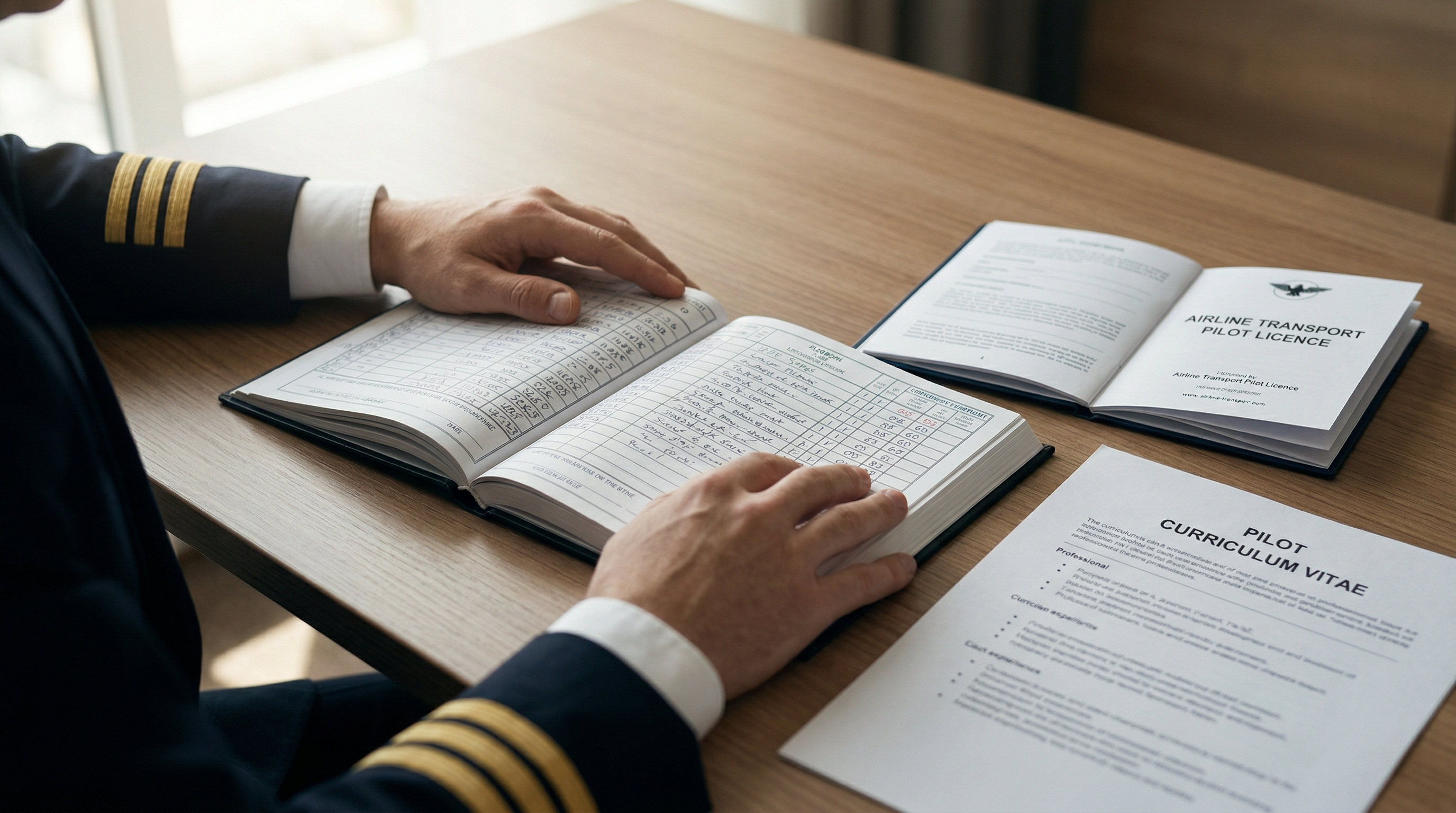
The technical interview is where your ATPL theoretical knowledge is put to work under pressure. The panel — usually two experienced pilots — will ask questions spanning aerodynamics, performance, meteorology, aircraft systems, air law, and non-normal procedures.
For a comprehensive breakdown of the 10 most common technical questions and model answers, read our dedicated guide: The 10 Most Common Technical Questions in Airline Interviews (available at clearatpl.com/blog). Here, three key points about approach:
1. Structure every answer in three layers
Definition → mechanism → operational relevance. A candidate who defines a stall correctly but never connects it to the recovery technique or the type certification standards has given a shallow answer. A candidate who works through all three layers demonstrates pilot thinking.
2. Don't bluff
If you don't know the precise answer, say so — then reason through it. 'I'm not certain of the exact figure, but my understanding is...' followed by structured thinking is far stronger than a confident wrong answer. Panels notice fabrication immediately, and it destroys trust in everything else you've said.
3. Your theory knowledge must be current
If you completed your ATPL theory more than 6 months ago, budget serious revision time before an interview. The material goes cold faster than most candidates expect. The best preparation is adaptive quizzing across all 13 subjects — which is exactly what ClearATPL (clearatpl.com) is built for.
Stage 4: The Competency-Based Interview (CBI)
The CBI is where more candidates fail than in the technical interview — not because the questions are harder, but because most pilots simply haven't prepared for them.
What is a competency-based interview?
A competency-based interview asks you to demonstrate — through real examples from your own experience — that you possess the specific behaviours the airline requires. Every question will be a variation of: 'Tell me about a time when...'
The panel is not looking for what you know. They're looking for evidence of how you actually behave. Theory is irrelevant here. Real examples, structured clearly, are everything.
The 7 core competencies airlines assess
- Application of knowledge and procedures — do you apply what you know correctly under pressure?
- Communication — are you clear, concise, and assertive without being aggressive?
- Workload management — can you prioritise, delegate, and stay focused in complex situations?
- Problem-solving and decision-making — do you gather information, consider options, and decide in time?
- Situational awareness — do you maintain a mental model of what's happening and what's about to happen?
- Leadership and teamwork — can you lead when necessary and follow when appropriate?
- Resilience and adaptability — do you recover well from setbacks and adapt to change?
How to use the STAR method
Every CBI answer should follow the STAR structure:
- Situation — briefly set the scene. Where, when, who was involved?
- Task — what was your specific responsibility in that situation?
- Action — what did you specifically do? (Not 'we' — the panel is assessing you)
- Result — what was the outcome? Quantify where possible. What did you learn?
Aim for 90 to 120 seconds per answer. Shorter feels unprepared. Longer loses the panel. Practise out loud with a timer.
5 CBI questions you must prepare
"Tell me about a time you had to make a difficult decision under time pressure."
Competency targeted: decision-making, workload management. Prepare an example where you had limited information, acted decisively, and can explain your reasoning clearly. Aviation examples are ideal; non-aviation is acceptable if aviation examples are limited.
"Describe a situation where you disagreed with a more senior colleague. How did you handle it?"
Competency targeted: communication, assertiveness, CRM. The panel wants to see that you can speak up — professionally and constructively — even when there's a power gradient. This is a direct test of safety culture.
"Give me an example of a time when you made an error. What happened and what did you learn?"
Competency targeted: resilience, self-awareness, learning culture. Do not say you've never made an error. Every pilot has. The panel is assessing whether you own mistakes, analyse them, and grow from them.
"Tell me about a time you had to manage multiple high-priority tasks simultaneously."
Competency targeted: workload management, situational awareness. Demonstrate that you can identify priorities, delegate where appropriate, and maintain a clear mental model even when task load is high.
"Describe a situation where you had to adapt quickly to an unexpected change."
Competency targeted: adaptability, resilience. Airlines operate in a constantly changing environment. Show that change doesn't destabilise you — it activates your planning instincts.
Stage 5: The Simulator Check
Not all airlines include a sim check for cadet or direct-entry FO positions. When they do, it is typically conducted in a fixed-base or full-flight simulator of the type the airline operates — though some use a generic twin-jet.
The sim check is a genuine flying assessment. The evaluator is testing real, concrete skills — and a weak performance on any one element can be enough to end your selection.
Here is what you will typically be asked to demonstrate:
Takeoff and departure
A standard instrument departure, often including a SID or a runway heading followed by ATC vectors. The evaluator is watching your handling on the ground roll, your rotation technique, your initial climb management, and how you sequence the after-takeoff actions. Rushing or skipping callouts at this stage is an immediate red flag.
Radial interception and VOR/NDB procedures
Many assessment centres include at least one radial intercept — tracking inbound or outbound on a VOR radial, intercepting from a given heading, or flying a holding pattern. This tests your raw instrument scan and your ability to apply the correct intercept angle without chasing the needle. Some assessments include an NDB approach or ADF tracking, which catches candidates who have only ever flown GPS.
ILS approach to landing
The ILS is the centrepiece of almost every sim check. You will be expected to intercept the localiser and glideslope from vectors, configure the aircraft on schedule, maintain stabilised approach criteria through the gate (1,000 ft AAL in IMC), and either land within the touchdown zone or execute a missed approach on instruction.
The evaluator is not just watching the needles — they are checking that you call out deviations, cross-check instruments correctly, and manage the energy state precisely. A carrier who sees you chasing a full-scale deflection at 500 feet without calling a go-around will not be making you an offer.
Missed approach and go-around
Expect at least one instructed or triggered go-around. The evaluator wants to see a clean, immediate thrust application, positive rate climb, gear retraction on schedule, and correct execution of the published missed approach procedure — all while maintaining communication with your FO and ATC. Hesitation or a missed callout here costs marks.
Non-normal procedures
An engine failure is almost always included — typically either on the takeoff roll (before or at V1), on departure, or on final approach. The evaluator is assessing whether you maintain aircraft control first, prioritise correctly (aviate, then checklist), and manage the crew through a structured non-normal without rushing or skipping steps. Some assessments also include a pressurisation failure or hydraulic abnormality to test your systems knowledge under pressure.
CRM and crew communication throughout
Running through all of the above, the evaluator is simultaneously assessing how you operate as a crew member. This means: briefing each phase clearly before you fly it, giving standard callouts at the right moments, cross-checking with your FO, responding to their inputs professionally, and maintaining an audible running commentary on your priorities and intentions. CRM is not a separate tick-box — it is woven into every second of the sim check.
Key principle: the sim check is not looking for a perfect performance. It is looking for a structured, safe pilot who manages deviations professionally, communicates clearly throughout, and keeps the crew in the loop at all times. A minor tracking error corrected promptly and called out is far less concerning than a candidate who flies silently and reacts late.
The 4-Week Preparation Plan
Four weeks is a realistic minimum for focused interview preparation assuming your ATPL theory is reasonably current. Adjust the timeline based on how recently you completed your exams and how much flying experience you have.
Week 1 — Foundations
- Revise all 13 ATPL subjects using adaptive quizzing — focus on your weakest areas first
- Write down 10 personal examples covering all 7 core competencies (two examples per competency gives you flexibility)
- Research the airline thoroughly: fleet, network, values, recent news
- Practise 5 numerical reasoning and 5 verbal reasoning tests online
- Read your ATPL notes on Performance, Principles of Flight, and Meteorology in depth
Week 2 — CBI and Technical Depth
- Structure your 10 personal examples using the STAR format — write them out fully
- Practise speaking your STAR answers out loud to a timer (target: 90 seconds each)
- Work through the 10 most common technical questions — speaking each answer aloud
- Continue daily quizzing across all subjects — aim for 85%+ per subject
- Identify any technical topics where you consistently score below 80% and go back to basics
Week 3 — Simulation and Pressure Practice
- Run full mock CBI sessions — with a friend, a colleague, or an AI simulator
- Run timed technical question sessions: 10 questions, 90 seconds each, no notes
- If a sim check is likely: book a refresher in a simulator or at a flight school
- Prepare your 'Why this airline?' answer in detail — researched, specific, genuine
- Prepare your 'Tell me about yourself' 90-second summary — practise it until natural
Week 4 — Refinement and Day Preparation
- Focus quizzing on your remaining weak areas — not broad revision
- Review your STAR examples: are they specific? Do they demonstrate the target competency clearly?
- Prepare physically: regular sleep, no late nights, moderate exercise
- Prepare your documents: licence, logbook, medical certificate, references
- Do one final full mock interview the day before — not to cram new material, but to settle your rhythm
The Day Before and Day Of
The day before:
- Do not attempt to learn new material. Your brain needs consolidation time, not new input.
- Review your STAR examples lightly — not to memorise, but to refresh.
- Confirm logistics: location, transport, time, what to bring.
- Sleep. This is more valuable than any additional revision.
What to bring:
- ATPL licence (original or certified copy)
- Class 1 medical certificate (valid)
- Pilot logbook
- Passport / national ID
- Any certificates requested by the airline (MCC, type rating, CRM, etc.)
- Two copies of your CV
On the day:
- Arrive early — 30 minutes before the scheduled start. Being late is eliminatory at most carriers.
- First impressions start before the interview room. The receptionist, the other candidates, the HR staff — everyone forms an impression.
- Dress professionally — formal business attire unless specifically told otherwise. When in doubt, overdress.
- In the interview room: slow down. Nervous candidates speak too fast. Take a breath before answering. Structured silence is not weakness — it signals composure.
- If you don't understand a question, ask for clarification. 'Could you give me an example of what you're looking for?' is a professional response, not a sign of confusion.
- After each answer, stop. Don't fill silence by adding unnecessary qualifications. Say what you need to say and let it land.
One final point that most guides skip: write a brief note after the interview while it's fresh — what questions were asked, how you answered, what you would do differently. Whether you get the job or not, this debrief will make you sharper for every future selection.
Key Takeaways
- An airline assessment is multi-stage. Psychometrics, technical interview, CBI, and sim check each test something different — and each is eliminatory.
- Psychometric tests eliminate more candidates than technical interviews. Don't underestimate them. Practise format familiarity, not just knowledge.
- The CBI is where most pilots fail — not because they lack competencies, but because they haven't prepared structured, specific examples in advance.
- The STAR method (Situation, Task, Action, Result) is the format for every CBI answer. 90 seconds. No padding. Stop when you've landed the result.
- The sim check tests real flying skills: takeoff, radial interception, ILS to landing, missed approach, and engine failure procedures. CRM and crew communication run through all of it — one does not replace the other.
- The best technical preparation is adaptive quizzing across all 13 ATPL subjects with regular mock sessions under time pressure — not passive reading.
- Start preparing for your airline interview during ATPL theory study, not after. The overlap is enormous and the compounding benefit is significant. ClearATPL (clearatpl.com) is built specifically for this.
FAQ
How many flight hours do I need before applying to a European airline?
Requirements vary by carrier and by the type of position. Most European low-cost carriers running cadet or MPL programmes do not require prior hours — you enter ab initio. For direct-entry FO positions, requirements typically start at 200–500 hours multi-engine instrument time, with some carriers requiring multi-crew or jet time. Check each airline's specific minimums.
Do I need an APS MCC before applying?
An APS MCC (Airline Pilot Standards Multi-Crew Cooperation) is not legally required under EASA regulations, but many European carriers list it as a preference or de facto requirement for direct-entry applications. It demonstrates multi-crew readiness and significantly strengthens an application.
How long does the full assessment process take?
From application submission to a conditional offer typically takes 2–6 months at a major European carrier. Low-cost carriers with high hiring volumes sometimes compress this to 4–8 weeks. Expect significant variability depending on the airline's hiring pipeline at the time you apply.
What should I do if I fail a stage?
Most airlines impose a mandatory waiting period before reapplication — typically 6–12 months. Use that time purposefully: debrief honestly, identify the specific area that failed, and address it. A single failed selection is not a career ender. Multiple failures at the same stage without targeted remediation is a different problem.
Can I prepare for the simulator check without flying?
Some preparation is possible through mental rehearsal, briefing practice, and studying the expected profile (departure, radial intercepts, ILS, missed approach, engine failure). Reviewing VOR/NDB procedures on paper is useful if your instrument flying is rusty. But there is no substitute for actual time in a simulator or aircraft before a sim check — the motor skills, scan patterns, and energy management need to be current. If your flying has been dormant for more than 6 months, budget for a refresher session before the assessment.
Is it worth using an interview coaching service?
For the CBI specifically, a coached mock interview with structured feedback is highly valuable — it is very difficult to objectively evaluate your own communication style and answer structure. For the technical section, disciplined self-study with tools like ClearATPL is typically sufficient without external coaching.
Conclusion
The airline interview is not a test of whether you can fly. That is assumed. It is a test of whether you can think, communicate, and perform under observation — and whether the panel would want to share a cockpit with you.
The candidates who succeed consistently are not necessarily the most talented pilots in the room. They are the ones who prepared the most systematically: they know the technical material cold, they have five structured STAR examples per competency ready to deploy, they have researched the airline in depth, and they have practised under pressure enough that the interview room doesn't feel unfamiliar.
That preparation is a skill, and it is entirely trainable.
ClearATPL (clearatpl.com) offers an AI-powered airline interview simulator built on real EASA assessment patterns, combined with adaptive quizzing across all 13 ATPL subjects. It's the only tool designed to build both technical knowledge and interview performance simultaneously — so that when your invitation arrives, you're already ready.
You might also want to read our related guides: 8 Proven Strategies to Pass Your ATPL Exams and The 10 Most Common Technical Questions in Airline Interviews — both available at clearatpl.com/blog.