
Quick Answer: Airline pilot assessments are multi-stage selection processes that test technical knowledge, cognitive aptitude, competency behaviours, and basic flying skills in a simulator. The majority of candidates who fail pilot assessments do so not because they lack the ability — but because they underestimate specific stages, prepare the wrong things, or make avoidable errors under pressure. This guide covers 12 concrete tips that apply across all EASA airline pilot assessments, from cadet programmes to direct-entry FO selections.
Table of Contents
- Understand the full structure of pilot assessments before you apply
- Treat psychometric tests as a separate skill — and train for them
- Refresh ATPL theory before every pilot assessment, without exception
- Prepare a structured story bank before the competency interview
- Research the specific airline, not just aviation in general
- Know the difference between what each stage is actually measuring
- Never underestimate the group exercise
- In the simulator check, prioritise communication over perfection
- Avoid the five most common reasons candidates fail pilot assessments
- Prepare your documents and logistics in advance
- Debrief every pilot assessment — pass or fail
- Start preparing earlier than feels necessary
Why Most Pilots Fail Pilot Assessments
Airline pilot assessments are among the most competitive selection processes in any professional field. At major European carriers, acceptance rates for direct-entry FO positions can be below 5% of applicants reaching the assessment stage. At cadet programmes, the ratio is often even more selective.
The pilots who succeed in airline pilot assessments are not always the most technically gifted in the room. Research consistently shows that the differentiating factors are preparation quality, self-awareness, and the ability to perform consistently across multiple stages — not raw flying skill or examination results alone.
The 12 tips in this guide address the specific areas where prepared candidates outperform unprepared ones in pilot assessments. Each tip is grounded in the structure of real EASA airline selection processes — not generalised interview advice.
Tip 1 — Understand the Full Structure of Pilot Assessments Before You Apply
A significant number of candidates arrive at pilot assessments without a clear picture of how many stages are involved and what each stage eliminates candidates for. This is a strategic error.
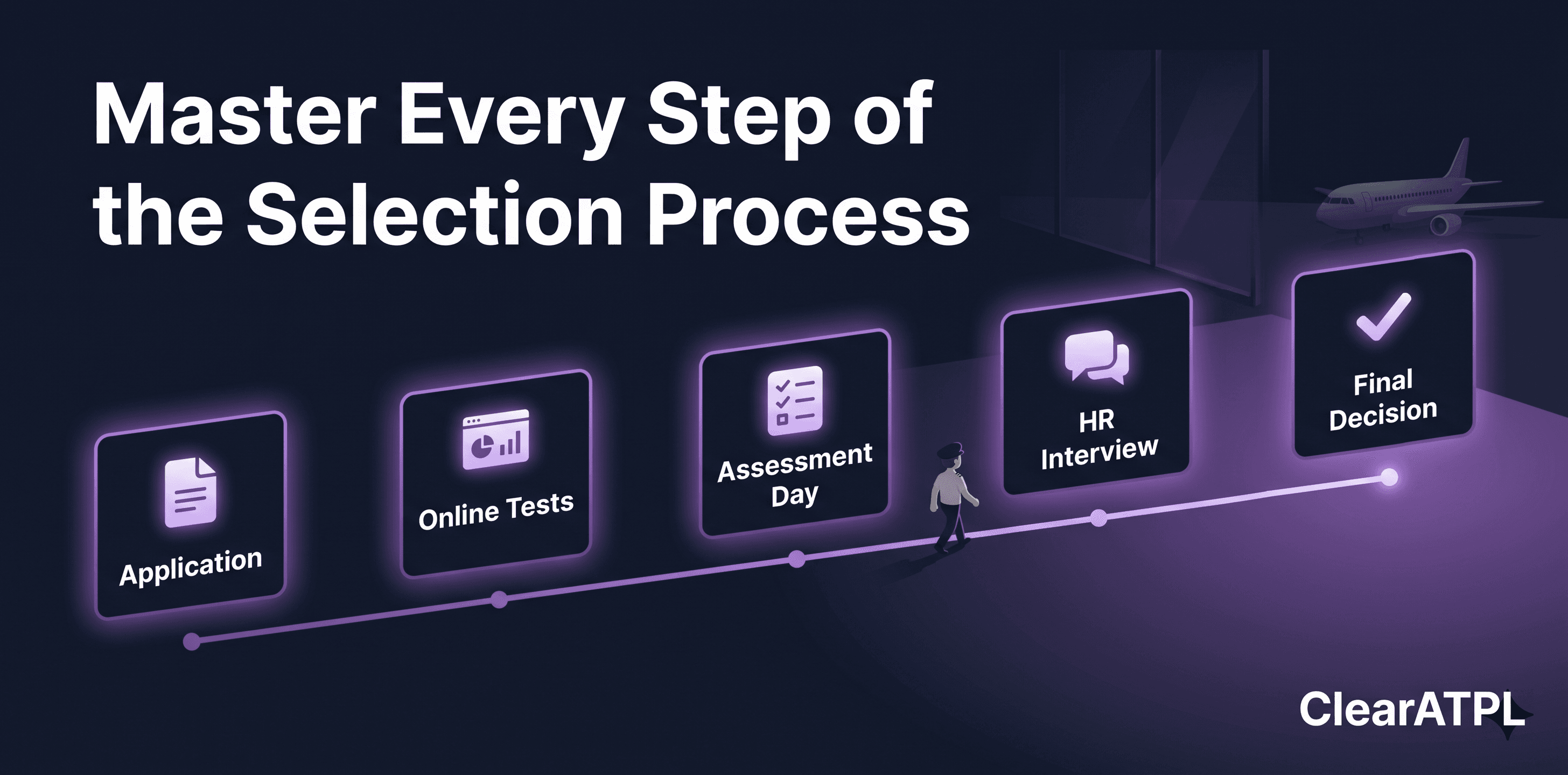
Most EASA airline pilot assessments follow this structure, with variations by carrier:
| Stage | What it tests | Elimination rate |
|---|---|---|
| CV and document screening | Minimum qualifications, licence validity, hours | High — automatic filters remove non-compliant applications |
| Online aptitude / psychometric tests | Cognitive ability, multi-tasking, personality | Highest elimination stage at large carriers |
| Technical interview | ATPL theoretical knowledge and operational judgement | Moderate — structured and predictable with preparation |
| Competency-based interview (CBI) | Evidence of core pilot competencies via past examples | High — most candidates are underprepared for this stage |
| Group exercise (where applicable) | CRM, communication, leadership/followership | Variable — depends on carrier format |
| Simulator check | Basic handling, instrument procedures, non-normals, CRM | Lower — candidates reaching this stage are pre-screened |
| Medical and background verification | Class 1 medical, employment history, criminal record | Low — largely documentary |
Understanding which stages are eliminatory — and in what order — determines where preparation time should be allocated. Spending four weeks on technical revision while neglecting psychometric test practice is a common and costly mistake in pilot assessment preparation.
Tip 2 — Treat Psychometric Tests as a Separate Skill — and Train for Them
Aptitude and psychometric tests are consistently the stage of pilot assessments that eliminates the most candidates at major carriers — yet they receive the least dedicated preparation.
Aviation-specific pilot assessment tests include platforms such as PILAPT, COMPASS, Cut-E, and AON. These tests measure spatial reasoning, multi-tasking ability, hand-eye coordination, numerical reasoning, attention under load, and psychomotor tracking — skills that do not improve simply through flying more hours.
Effective preparation for this stage of pilot assessments involves:
- Familiarisation with the test format — knowing what to expect removes the anxiety penalty on test day, which alone improves performance by a measurable margin.
- Numerical and verbal reasoning practice — SHL Direct and similar platforms offer free practice tests; daily sessions over 3–4 weeks produce significant improvement.
- Multi-tasking tolerance — some candidates find the dual-task format of PILAPT and COMPASS disorienting on first exposure; practice reduces the cognitive load of the format itself.
- Personality questionnaires — these have no single 'correct' answer, but inconsistency is detected algorithmically; answer authentically and consistently throughout.
Critical point: aptitude test results cannot be meaningfully improved by last-minute cramming. The preparation window for psychometric tests should start at least 4–6 weeks before the pilot assessment date, with short daily practice sessions rather than intensive blocks.
Tip 3 — Refresh ATPL Theory Before Every Pilot Assessment, Without Exception
One of the most reliable predictors of failure in the technical stage of pilot assessments is allowing ATPL theoretical knowledge to go cold. Candidates who completed their exams more than six months before the assessment and did not actively revise consistently underperform against candidates with more recent knowledge exposure.
The technical interview in airline pilot assessments does not require verbatim recall of ATPL material. It tests whether the candidate can explain concepts clearly, reason through applied scenarios, and connect theory to operational practice. This requires active, retrievable knowledge — not passive familiarity.
The subjects most frequently tested in airline pilot assessment technical interviews are:
- Principles of Flight — stall, V-speeds, high-speed aerodynamics, coffin corner.
- Performance — take-off analysis, engine failure procedures, obstacle clearance.
- Meteorology — frontal systems, icing, wind shear, microburst.
- Operational Procedures — stabilised approach criteria, fuel policy, alternate requirements.
- Radio Navigation — ILS components and categories, RNP/RNAV distinctions.
- Air Law — flight time limitations, licensing requirements, emergency procedures.
clearatpl.com offers adaptive quizzing across all 13 ATPL subjects — specifically designed to identify and target weak areas before a pilot assessment. The AI-powered question engine adjusts to performance in real time, focusing revision time on the topics most likely to cost marks in a technical interview.
Tip 4 — Prepare a Structured Story Bank Before the Competency Interview
The competency-based interview (CBI) is the stage of pilot assessments that most candidates are least prepared for — and where the most preventable failures occur.
A CBI requires concrete examples from real experience that demonstrate specific pilot competencies. The panel is not looking for theoretical knowledge or hypothetical answers — they need evidence of actual behaviour. The STAR framework (Situation, Task, Action, Result) structures that evidence clearly.
Effective preparation for the CBI stage of pilot assessments requires building a story bank before the assessment date — not improvising in the interview room. The recommended approach:
- Identify the 7 core competencies assessed in airline pilot assessments: Application of Knowledge, Communication, Workload Management, Problem-Solving, Situational Awareness, Leadership & Teamwork, Resilience.
- For each competency, document at least two real examples from training, flying, or any professional context — specific, with measurable outcomes.
- Structure each example using STAR: Situation (brief), Task (your role), Action (what you specifically did), Result (what happened and what you learned).
- Practise delivering each example out loud within 90 seconds — the panel is not reading a script; they are assessing communication quality under pressure.
Candidates with limited flying experience often believe they cannot provide strong CBI answers. This is incorrect. Competencies such as communication, workload management, and leadership are demonstrated in any professional or high-pressure environment — academic, military, commercial, or sporting. The aviation context is preferred but not mandatory.
ClearATPL's airline interview simulator (clearatpl.com) is designed specifically for this preparation stage. It presents competency-based questions from real airline pilot assessments and provides structured feedback on answer quality — so candidates build their story bank under simulated pressure before the actual assessment day.
Tip 5 — Research the Specific Airline, Not Just Aviation in General
Every airline pilot assessment includes at least one moment where the panel tests whether the candidate has done genuine research on the organisation. The question may be direct ('Why do you want to work for us?') or embedded in a competency question ('Tell me about a time you prepared thoroughly for something important.').
Generic answers — 'you have a great safety culture' or 'I admire your growth trajectory' — are immediately identifiable and reflect poorly. The research that impresses panels in airline pilot assessments is specific:
- Fleet: current aircraft types, number of aircraft, upcoming deliveries, any type rating implications for the role.
- Network: short-haul or long-haul, key routes, bases relevant to the application.
- Recent news: new route announcements, fleet changes, financial results, leadership changes, sustainability initiatives.
- Company values and pilot competency framework: if the airline publishes these, map the CBI preparation directly to their stated competencies.
- Operational context: what kind of flying does this airline actually do, and what does that mean for daily life as an FO at this carrier.
Tip 6 — Know the Difference Between What Each Stage Is Actually Measuring
A recurring error in pilot assessment preparation is treating every stage as a knowledge test. The different stages of airline pilot assessments measure fundamentally different things — and applying the same preparation strategy to all of them is ineffective.
| Stage | What it actually measures | What it does NOT measure |
|---|---|---|
| Aptitude tests | Cognitive processing speed, multi-task capacity, spatial ability | Flying knowledge, ATPL content, personality |
| Technical interview | Depth of understanding, ability to reason through scenarios | Verbatim recall of regulations or procedures |
| CBI | Evidence of past behaviour as a predictor of future behaviour | Hypothetical responses or theoretical knowledge |
| Group exercise | How a candidate interacts within a team under mild pressure | Leadership dominance or individual performance |
| Simulator check | Trainability, crew coordination, structured handling | Perfection — examiners expect and accept errors |
Tip 7 — Never Underestimate the Group Exercise
Not all airline pilot assessments include a group exercise, but when they do, it is one of the stages candidates most consistently underestimate. The typical format involves a group of 4–8 candidates working on a scenario together — a resource allocation problem, a priority-setting exercise, or a team decision under time pressure.
The panel is not observing who has the correct answer. They are watching the dynamics: who listens, who builds on others' ideas, who takes the discussion forward when it stalls, who respects competing views without becoming passive.
The behaviours that create positive assessor impressions in the group stage of pilot assessments:
- Listening actively and visibly — make eye contact, acknowledge contributions.
- Building on what others say rather than starting new threads without acknowledgement.
- Inviting quieter candidates to contribute — 'We haven't heard from everyone yet'.
- Keeping the group on task when discussion drifts without dominating.
- Summarising progress clearly when the group loses focus.
The behaviours that create negative impressions — and can fail a candidate who performed well in all other stages:
- Dominating the discussion or talking over others.
- Withdrawing and making minimal contribution.
- Dismissing others' ideas without engaging with the reasoning.
- Losing composure when challenged or overruled by the group.
Tip 8 — In the Simulator Check, Prioritise Communication Over Perfection
The simulator check component of airline pilot assessments is the stage most candidates fear disproportionately — and misunderstand fundamentally.
Airlines conducting pilot assessments at the entry level are not looking for a candidate who flies a perfect ILS. They are assessing trainability — the ability to take instruction, apply corrections, and operate as part of a crew from the first session. A candidate who flies slightly imperfectly but verbalises everything clearly, responds to callouts, briefs the approach out loud, and manages the non-normal procedure with structure consistently outperforms a candidate who flies technically well but operates silently.
The simulator check in airline pilot assessments typically includes:
- Takeoff and initial departure — handling, callouts, SID or heading compliance.
- Radial interception and instrument tracking — VOR/NDB, intercept technique.
- ILS approach to decision height — localizer and glideslope tracking, stabilised approach criteria, go-around or landing decision.
- Engine failure — identification, control, checklist execution, crew coordination.
- CRM throughout — briefings, standard callouts, monitoring of the FO/evaluator.
Practical advice: brief every phase before flying it. Say it out loud. State what you're doing and why as you do it. Thank the evaluator for callouts. If something goes wrong, acknowledge it, correct it, and move on — the recovery matters more than the error.
Tip 9 — Avoid the Five Most Common Reasons Candidates Fail Pilot Assessments
Analysis of pilot assessment outcomes across European carriers consistently identifies the same failure patterns. Awareness of these patterns is the first step to avoiding them.
Inconsistency across stages
Candidates who perform well in the technical interview but poorly in the CBI — or vice versa — create doubt about their reliability. Airlines want consistent evidence of competence. A candidate who can answer a technical question about the ILS but cannot give a structured example of managing workload raises a flag about whether their knowledge is operationally integrated.
Underestimating the psychometric stage
This is the single most common avoidable failure in pilot assessments. Many strong candidates eliminate themselves before the interview stages because they treated aptitude tests as something that 'cannot be prepared for.' Format familiarity and regular short practice sessions make a measurable difference.
Generic CBI answers without specific evidence
'I always prioritise safety' is not a CBI answer. 'In a situation during my IR training where...' followed by a specific action and a specific result — that is a CBI answer. Panels conducting pilot assessments are trained to probe vague responses until the candidate produces something specific or runs out of material. Specific examples prepared in advance prevent this from happening.
Bluffing on technical questions
Experienced technical interviewers in pilot assessments identify fabricated answers within seconds. A confident wrong answer is more damaging than an honest 'I'm not certain, but my understanding is...' followed by structured reasoning. Intellectual honesty under pressure is itself a positive signal.
Poor preparation for the specific airline
Arriving at a pilot assessment without knowing the airline's fleet, base structure, or recent news is a visible signal of low motivation. The question 'Why do you want to work for us specifically?' is asked at virtually every airline pilot assessment in some form. A generic answer to this question consistently damages overall assessments.
Tip 10 — Prepare Documents and Logistics in Advance
Logistical failures on pilot assessment day are avoidable and costly. Arriving late, missing a document, or appearing visibly disorganised creates an immediate negative impression that is difficult to reverse in the limited time available.
Documents to prepare and verify before any pilot assessment:
- ATPL or frozen ATPL licence — original or certified copy.
- Class 1 medical certificate — valid and in date.
- Pilot logbook — up to date, hours accurately totalled.
- Passport or national identity document.
- Any certificates specifically requested: MCC, APS MCC, type rating, English proficiency.
- Two printed copies of the CV submitted with the original application.
Logistics to confirm 48 hours before the pilot assessment:
- Exact location of the assessment centre — many airlines use assessment locations different from their main offices.
- Planned arrival time — aim for 30 minutes before the stated start time.
- Dress code — formal business attire unless explicitly told otherwise.
- Contact number for the recruitment team in case of unexpected delays.
Tip 11 — Debrief Every Pilot Assessment — Pass or Fail
The pilots who accumulate the strongest pilot assessment track records over time share a common practice: they debrief every assessment immediately after, while the details are fresh.
A systematic post-assessment debrief involves documenting:
- Every question asked in the technical interview and how it was answered.
- Every CBI question asked and which competency it was targeting.
- Moments of hesitation or uncertainty — what topic or competency triggered them.
- Any questions that were unexpected or poorly handled.
- Physical and mental state during the assessment — was performance affected by nerves, time pressure, or sleep quality.
This debrief data becomes a preparation asset for the next pilot assessment. Candidates who attend multiple airline selections and do not debrief make the same errors repeatedly. Candidates who debrief systematically improve their performance with each attempt — regardless of outcome.
Most airlines impose a waiting period of 6–12 months before reapplication. That window is preparation time, not waiting time. Using it to address the specific gaps identified in the debrief is the most efficient use of the available runway.
Tip 12 — Start Preparing Earlier Than Feels Necessary
The most consistent finding across successful airline pilot assessment candidates is that preparation started earlier than they initially expected to need. The minimum effective preparation window for a full pilot assessment — covering all stages — is four to six weeks of structured daily preparation.
The stages that benefit most from early preparation are:
- Psychometric tests — require weeks of daily short sessions; cannot be crammed in the final 48 hours.
- ATPL theory — if more than three months since active study, budget two to three weeks of targeted revision across all 13 subjects.
- Story bank for CBI — identifying, structuring, and practising twelve to fifteen STAR examples takes time and multiple revision passes.
- Simulator currency — if flying hours are inactive or low, a refresher session cannot be scheduled last-minute.
The ideal preparation model integrates ATPL revision with interview preparation simultaneously — because the overlap between technical knowledge and technical interview content is substantial. Pilots who study theory and prepare interview answers in parallel build deeper, more operationally connected knowledge than those who treat them as separate workstreams.
clearatpl.com is built for exactly this preparation model. Adaptive ATPL quizzing across all 13 subjects runs alongside an AI-powered airline interview simulator — so technical knowledge and pilot assessment readiness are developed together, not sequentially. Start on the free plan and build from there.
Key Takeaways
- Airline pilot assessments are multi-stage processes — each stage is eliminatory and tests something different. Understanding the structure before applying is the first preparation step.
- Psychometric tests eliminate more candidates in pilot assessments than any other stage at major carriers. Prepare specifically for these, at least 4–6 weeks in advance.
- ATPL theory goes cold. Refresh it before every pilot assessment — adaptive quizzing with tools like clearatpl.com is the most efficient method.
- Build a story bank of 12–15 structured STAR examples before the competency interview. Generic answers fail consistently in airline pilot assessments.
- Research the specific airline in depth — fleet, network, values, recent news. Generic motivation answers are identifiable and costly in pilot assessments.
- In the simulator check, trainability and communication matter more than technical perfection. Brief every phase out loud; verbalise your thinking throughout.
- The five most common failure reasons in pilot assessments: inconsistency across stages, underestimating psychometrics, vague CBI answers, bluffing on technical questions, and poor airline-specific research.
- Debrief every pilot assessment immediately after — this data drives improvement in the next attempt more than any other single practice.
- Start preparing earlier than feels necessary. The minimum effective window for a full pilot assessment preparation is four to six weeks.
FAQ
How long do airline pilot assessments typically take?
A full airline pilot assessment day — covering aptitude tests, technical interview, CBI, and simulator check — typically runs 6 to 8 hours. Some carriers split the process across two days. Cadet programme selections may include additional stages such as group exercises and psychological profiling, extending the process to a full assessment centre format over one or two days.
How many times can a candidate attempt the same airline's pilot assessment?
Most EASA carriers impose a minimum waiting period of 6–12 months between applications after an unsuccessful pilot assessment. Some carriers limit the total number of attempts. Always check the airline's specific reapplication policy before submitting a new application.
Are pilot assessments the same across all European airlines?
The structure is broadly similar — aptitude tests, technical interview, CBI, and simulator check — but the specific content, weighting, and format vary significantly by carrier. Low-cost carriers tend to run more compressed one-day assessments. Full-service carriers often use multi-stage processes with several weeks between rounds. Cadet programme pilot assessments typically include additional psychological and group stages.
What score is needed to pass the aptitude tests in a pilot assessment?
Airlines do not typically publish pass score thresholds for aptitude tests. Results are benchmarked against the candidate pool for that session or against the airline's historical database of successful candidates. The practical implication is that absolute performance matters less than relative performance — being above the norm for the applicant pool is the target, not achieving a fixed percentage.
Is it worth applying to a pilot assessment before feeling fully ready?
Applying before being fully prepared is generally inadvisable at airlines where reapplication waiting periods are long (12 months or more). A failed pilot assessment at a priority airline imposes a significant opportunity cost. For airlines where waiting periods are shorter (6 months), an early attempt can provide valuable real-world assessment experience — provided it is followed by a thorough debrief.
How important is the CV in getting invited to a pilot assessment?
The CV is a filter, not a selection tool. It determines whether the application passes automated screening and reaches a human reviewer. Airline aviation CVs follow a specific one-page format with licences and flight hours presented prominently. A CV that does not follow this format — or that buries key data — may be rejected before anyone reads the content.
Conclusion
Airline pilot assessments are demanding by design. They are structured to identify candidates who can perform consistently under pressure, communicate clearly, apply knowledge operationally, and function effectively as part of a professional crew from day one.
The 12 tips in this guide address the specific, recurring factors that separate successful candidates from unsuccessful ones in pilot assessments — not based on natural ability, but on preparation quality and strategic awareness. None of these factors are fixed. All of them are trainable.
The pilots who receive offers from competitive airline pilot assessments are, as a group, the pilots who prepared the earliest, practiced the most specific skills for each stage, researched their target airlines in genuine depth, and debriefed every attempt with honesty about what needed to improve.
clearatpl.com supports both the ATPL theory and the interview readiness dimensions of pilot assessment preparation. Adaptive quizzes across all 13 subjects identify knowledge gaps before the technical interview does. The airline interview simulator builds structured, confident answers to competency questions before assessment day. Free to start — no credit card required.